Holy City
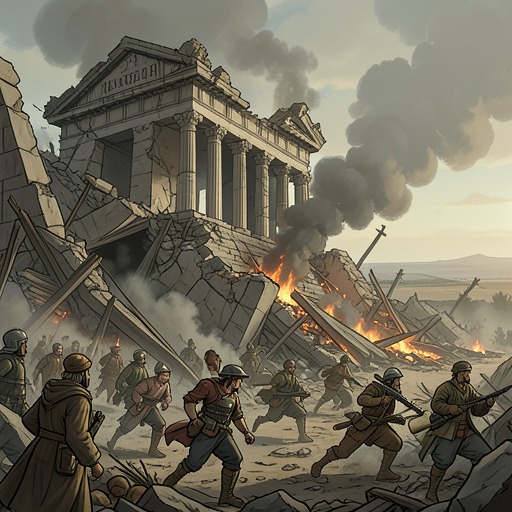
Awakening the Angel System: Apocalypse: A LitRPG Progression FantasyHoly City, the capital of the Theocracy, is both a sacred center and a battlefield. Its defenses, shrines, clergy, and military formations make the city a place where religious legitimacy is converted into material resistance, while its destruction and threatened survival mirror the broader collapse of established human powers.
Sacred Capital and Patronage
Holy City is presented through the statue of Saint Citri, the Theocracy’s patron saint and founder. Jack encounters the human-sized statue beneath an ice-covered church and immediately senses an inexplicable familiarity in its likeness, while Lita explains that the saint’s presence limits the power of demonspawn attacking the city. The statue is therefore not merely devotional art: it functions as a protective resource whose location the traitors are desperately searching for.
The scene acquires a deeper significance when Sahaqiel reacts with confusion and agitation to the statue. She does not understand why an image of her own likeness stands in the city, even as the faithful identify the figure with their patron saint. The apparent division between Sahaqiel as a living angel and Saint Citri as a revered religious founder exposes the gap between sacred history and the concealed truth of the world. Holy City’s theology is built around an image that may preserve a distorted or incomplete memory of Sahaqiel herself.
Fortress, Church, and Military Order
The sacred center is also heavily armed. Around the church, paladins, Templars, and black-robed clergywomen carry submachine guns and staves, combining modern weaponry with religious authority. The city’s defense thus rejects any simple division between the spiritual and the military: worship, ritual protection, and organized violence occupy the same architectural space.
This fusion becomes explicit when coalition forces assault the city. Holy City is engulfed in flames and ash as lead and ionized bolts pass between massive human-commanded machines. Jack, wearing white armor with silver wings, stands atop bodies and wreckage while abominations continue pouring from the enemy headquarters. What began as a blitz attack becomes a prolonged urban and aerial battle, leaving the city in ruins while coalition forces fight the High Table for access to its inner stronghold.
The citadel is the final visible objective of the assault, but Jack recognizes that the decisive target lies beneath it. After learning that Lita’s Judicators and Jack’s pink-haired ally have secured the secret tunnels and passageways, he boards an Eclipse-Class battle tank supplied by the Empire. Red-eyed golems flank the vehicle, while paladins move around Jack and Templars and Imperials salute him before the ruined gates. The scene turns the city’s devastated ceremonial architecture into a military threshold: the old citadel is broken, but the hidden facility beneath it remains intact and strategically decisive.
Sacred Knowledge and Buried Horror
Holy City’s religious spaces also conceal a traumatic history. Beneath the statue’s massive six wings lies a chapel, and within the chamber Jack encounters a choir of children singing in a language he cannot understand. Sahaqiel recognizes it as the language of the angels and weeps because she has not heard it since childhood. The sacred sound therefore produces not reassurance but grief, linking the city’s religious grandeur to a lost angelic past.
The contrast is central to Holy City’s atmosphere. Its statue promises protection, its clergy defend it with guns and staves, and its sacred language preserves a memory older than the current political order; yet the same sanctuary contains signs of suffering and secrets that even Sahaqiel cannot immediately explain. The city’s holiness is consequently unstable. It offers sanctuary against demonspawn while also sheltering the evidence of forgotten violence, institutional control, and concealed identity.
Symbol of Political Reversal
Holy City’s fate participates in the larger political transformation of the narrative. Jack later addresses imperial citizens as the son of the Queen Slayer and King Consort of Queen Selfia Cordelica, offering surrender and promising humane treatment in the Cordelica Democracy. His appeal directly challenges the Imperial war doctrine that forbids surrender while resistance remains possible, presenting the old order as dead and its citizens as capable of joining a different future.
Selfia’s subsequent address describes Lunacrypt, Soldaer, Clausterfiell, and Solarus as monuments destroyed or ruined by the enemy, framing the coming expedition as humanity’s necessary response to extinction. Although Holy City is not named in that speech, its military and sacred devastation belongs to the same historical crisis: cities that once embodied permanence are reduced to fronts in a war for survival. Holy City thus stands at the intersection of two reversals, the collapse of inherited religious and imperial authority and the attempt to replace it with a new political community justified by survival.
Narrative Significance
Holy City condenses the book’s central tension between faith and power. Its saint’s statue protects the capital, its worshippers treat Sahaqiel as a divine patron, and its soldiers defend the sanctuary with industrial weapons. Yet the living source of that veneration does not recognize the image, and the angelic song beneath it opens a wound rather than resolving the mystery.
The city is therefore more than a setting for combat. It is a contested memory made architectural: a capital whose sacred symbols organize resistance, whose underground passages conceal the true objective of war, and whose ruined citadel marks the failure of an older order. When Jack advances through its wreckage toward the facility below, the movement is simultaneously military penetration, historical excavation, and confrontation with the difference between what a civilization worships and what its sacred symbols actually remember.